Showing posts with label Anime. Show all posts

Tuesday, November 13, 2012

My Boy Friend


Included in the forth volume VHS of the Hoshineku Full House series is this little single.  Published by the Walkers Company Inc.  Vocals again from the talent group known as LISP, which have not appeared again till recently only on another soundtrack done by Nagaoka.  I'm not sure if they are the same people though.  A chorus joins in this time, name MILK, but no details on what the name comprises of.

01My Boy Friend4:28
02そしてすべてが終わり4:37
Disc length 9:05


My Boy Friend takes the lead as being the fun song with its amazing opener.  Certainly a huge touch of jazz is inserted for this one.  LISP stand out more and each singer can be heard even when singing together.  Despite the girly title, I don't feel it as being singled out for the female audience.  Second song is composed by Hitomi Kuroishi, so it feels a little more conservative in terms of music and pace.  Drums, vocals, and bass guitar are pretty laid back, which give off a romantic love feeling without pushing it too far as such. Both songs are pretty similar to each other, and definitely have a different tone then the singles from vol. 3.   Nagaoka's own composition and arrangement for the first song is certainly stronger then his last in vol. 3, Dancin' Twilight. 


Remember, this is the artists first real gig, at least as a solo artist.  Before this it was a few image albums that seemed to be like he was shadowing or interning as for experience.  I did not expect much difference in song making here, but behold there are some marked improvements.  Specifically in Nagoaka's control of the vocals.  Same vocalists but they feel more matured here and while the three vocalists of LISP sing over each other for most of the songs, each singer has a chance to take a few verses individually.  There is no fear of high notes being struck bad or at all, and no problem with the cute sounds of the synth board overlapping the vocals.  So I'm intrigued by how well Mr. Nagaoka has leveled his instrumentation and vocalists.  I still place Honeymoon as the best song of the four.  There is fortunately enough consistency between all of them.  Both single discs are worth the place in anyone's collection large or small.  

Friday, November 4, 2011

Trust / A confession of TOKIO


Since only the TV version of Trust was available on the original soundtrack of He is My Master, I had to get the full version.  Not only was there just the one song, but another original and the karaoke.  Though I don't think the other song was based off of the TV series.  

01Trust4:18
02A confession of TOKIO4:34
03Trust (instrumental)4:18
04A confession of TOKIO (instrumental)4:32
Disc length 17:42


The new song is arranged by Hideyuki "Daichi" Suzuki and composed by Hiroshi Uesugi, though its probably not that important.  Daichi himself, has done a huge number of arrangement on many anime and game titles.  This song was done near the beginning of his massive career and it shows his skill.  A confession of TOKIO,  is probably the more attractive of the two, simply because of the opener.  Rocking base and electric guitars fill the airs, smoothly corresponding with Masami's voice.  Drums are strong and none of the other instruments clutter over each other. 
A tribute to the gals of He is My Master.  
I'm not stereotyping, but TOKIO follows typically in the J-pop genre.  Trust, however, is a bit more difficult to categorize.  Being an opener for anime, the chorus is too childish for popular music.  Pop music itself has been tending to children lately anyway.  Masami composes this piece, and Mr. Nagaoka completes it for her, making it an overall great piece.  Instrumentally, I do like it just as good as the other, and better.  Masami's lyrics works great and effectively with the backing guitars performed by Nagaoka.  

Seikou Nagaoka may not be the best song writer, but what gives him an edge over other J-Pop artists is his improvisations.  After the second verse in the song, when the electric guitar takes the lead, is what makes his arrangement worth listening to.  The drawback is, like I said before, the chorus that is slightly overdone.  Vocals were done just right for TOKIO.  I also think Masami's vocals were more mature in TOKIO, although in Trust, her solo was spectacular.  Thankfully, she doesn't bother hitting such a high note.  

Album:A+                     Package:6   
Both songs are a great asset to anyone's collection.  Masami Okui doesn't have the high-pitched voice that is standard of the anime industry.  That alone should be enough reason to own this.  I'm glad that the karaoke versions were included, as they were both great instrumentally.  Nagaoka especially gets kudos for his performances.  The only thing is that the background chorus' were left in there, though it shouldn't be much in the way of enjoying a vocal-less song.  In terms of package, I don't know why they would waste an entire CD, for it could have fit on a CDS.  


Thursday, August 25, 2011

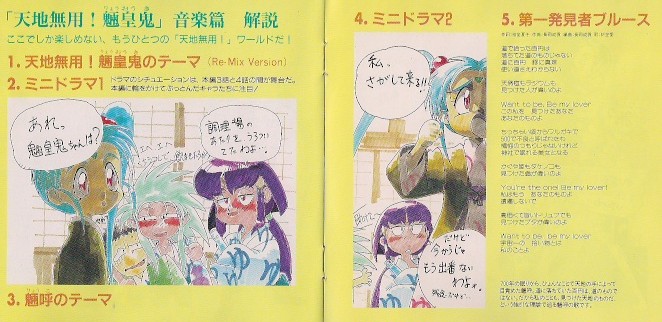
Tenchi Muyo! Ryo-Ohki Ongaku Hen 1

PICA-1003 
'92.08.25
I remember a different version of the cover.  Mihoshi was in place of Washu.  I find that odd, that all characters are shown before the release of the first episode, which comes out a month later.  It's a good way to get a feeling the characters before they go on screen.  Though, I'd rather have them come out as a surprise, then have this come out.  Anyways, there is a lot planned for the future with this CD.
One would expect an OST to mainly consist of, well, ORIGINAL MUSIC!! There are 8 short dramas, couple character songs, few instrumentals, and OP/ED themes in their full glory.  Chisa Yokoyama, Sasami's Seiyuu, sings the ending theme. Composed by Ikuru Fujiwara, the man behind most Pioneer/AIC theme songs.  He does an excellent job of capturing the fun in the anime in this one song.  Chisa's voice is actually not that annoying.  I can listen to this song without any qualms.  Even when compared to the amazing English versions.

Unfortunately, the original OAV theme opener does not lay anywhere on this disc, but we do get the Original Version and the Re-Mix Version.  Oddly, they place the remix first and the original last.  The original, of course, stays true to the opener, only getting into the main arrangement immediately.  Some haunting vocals have been added. Love hearing the bass.  Drums are masterful.  The jingles and japanese acoustic give great flavor.  Just when you think its over at 1:50 it loops, but doesn't give the feeling of repitition.  As Nagaoka, improvises it even further.  The remix version, is not necessary, and kind of can be a turn-off.  The drums are more ethereal here, as well as other instruments.  I was expecting more use of synthesizers, but all instruments sound authentic on this one.  The piece does feel a little slower.  I actually I am happy with the turnout. 

I've avoided the character songs for to long.  If not for this review, I wouldn't have embraced how well done these songs are.  Ryoko's seiyuu, Ai Orikasa, takes the mic in Daiichi Hakkensha Blues.  The smooth rythym posed in this song goes along with the cover.  As in, it gives off the whole jazz club feeling.  Nagaoka and Oriakasa should go together more often.  She does express her seduction as the character would in this song. 

Away from the R&B section, Yumi Takada, poses as Aeka, and sings us a ballad.  Seikou puts the Juraian themes in this song.  Piano, harps, oboe and snare drums occupy the entire track.  Takada is accompanied by some male vocals at the end.  All leading to a triumphant finish. 

Both Takada and Orikasa follow Masami Kikuchi in a duet, only with three people.  Ueno No Koi No Monogatari continues the rythym and blues theme.  I guess jazz and R&B is not so bad when in the hands of Nagaoka.  Ryoko and Aeka bicker with each other, trying to out sing one another.  The song almost falls apart hilariously at the end. 
Now for the radio dramas, constructed by none other, lady Nahoko Hasegawa.  It's worth actually getting into these voiced adventures.  Out of the Tenchi dramas, these are my favorites, because she truly expresses the characters in a unique way.  Hayashi Hiroki even sketches out the scenario for each drama.  Giving an extra method to understanding the dialog for non-Japanese speakers.
Mini-Drama 1 sounds like they are at bar.  Again, accurately depicted in the sketch above.  Ryoko is daydreaming or something and Aeka breaks the fantasy.  Then Aeka gets drunk as well, and she gets into her monologue.  Things get wild with some rapid footwork.  Aeka gives some shock therapy that tickles Ryoko. 

Ryoko's Theme follows.  A great representation of the character.  In one of the many Tenchi books, Seikou states that Ryoko is his favorite character.  It certainly shows here.  The track is filled with a strong beat, synthesizers depict Ryoko's fiestiness, and at the same time her lonliness. 

Second mini-drama, is a short Ryoko monologue.  Tenchi and Sasami are spying on her.  Trying to keep quiet and laugh at Ryoko's thoughts.  Ayeka gets the third mini-drama, for the full 30 seconds.  Then in the fourth, it's both of the girls, discussing something.  Aeka looks for Tenchi's attention, but does not respond.  She then yells for a response.  Ryoko laughs at the relationship.  Tenchi seems very overpowered here, but at least he says somethings.  Sasami is picked on for some reason. 
The middle of the OST has some long instrumentals.  The first is the Ryo-Ohki Summoning, or Sneaky Tenchi theme.  Bass, violins, and some acoustics quietly fill in for two minutes, before some percussive instruments take charge for another two minutes.  It feels tense as it should, and the synth helps add character.  Aeka's theme follows.  Might take some time to actually like.  Percussion and ethnic Japanese strings set the mood for the piece.  Acoustic rythyms and pace establish the peaceful and proper nature that is Aeka.  The opposite of Ryoko.  Don't skip this theme, becuase then the character can't be fully understood.

The Destruction of the Saito Bridge, begins with synthesizers and a beat, signifying that something is emerging.  The intensity builds, before some snare drums and ticking sounds give it speed.  The oboe moves in for the evolution of the BGM.  Guitars start getting pressed on to show the gravity of the situation.  At two minutes the action begins.  Oboe, clarinet and strings represent the fall of the ships.  An epic track that deserves the repeat treatment.

Mini-drama 5, has Tenchi on the edge.  Sasami and Aeka try to play karaoke.  Sasami comes out of no where laughing in the sixth drama.  Tenchi is running again. 
Another Aeka BGM insert.  This sweet piano/oboe ballad is very welcoming, but is put to shame by the next BGM.  The instrumental gem, Royal Teardrop of Jurai.  I'm not even going to describe how powerful this ensemble is.  A majestic symphony.

In the 8th drama, Ryoko sings her song which wakes up and annoyes Aeka.  Whereas, in 7, Ryoko and Aeka are sneaking in the middle of the night and cross each other.  They do battle. Aeka seems to be doing some damage.  Sasami is awoken, wakes up Tenchi, and he has a fit by the girls destruction.  They simmer down and pout about it. 
Kajishima provides the character illustrations.  Artwork that I cannot find in any other Tenchi media. The Washu uniform is sleek.  Wish it was used in the anime.  Pioneer does not mess around when it comes to extra's, but where is the music.  The booklet is complete with images and descriptions.  In my opinion, over the top design.  Booklet barely fits in the case.  Package: 10/10

What is provided here is beyond complaint.  The cuts between the tracks were off.  It was as if it was all recorded in sit.  A split second of the drama echoes into the BGM song.  The BGM song carries on into the drama.  With only 6 actual BGM's, it's hard to really grade the musical world of Tenchi.  There could have been the Tenchi and Sasami themes at least.  Aeka's themes may bore the listener, but they are quite essential.  The rest of the soundtrack is a party, and Ryoko alone is a fiesta.  Album: A...

Sunday, January 16, 2011

暗黒神伝承 武神 -Takegami:Guardian of Darkness

File:Guardian of Darkness.jpg

The only reason I obtained this DVD is because of my interest in Seikou Nagaoka's music.  He's the only reason why I'm exploring other anime.  I always go back to this DVD every now and again just to hear this epic score.  I'm mad that it didn't get a soundtrack, especially since there is a song at the end. 
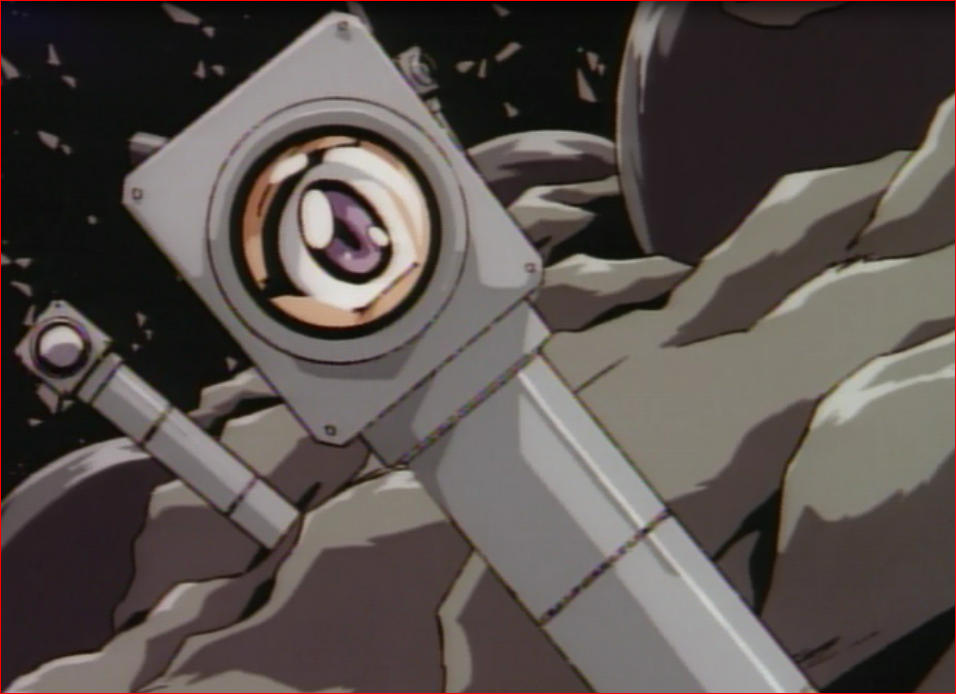
A three episode OAV, is something really not worth passing.  Any longer would probably be a drag.  This anime is dark, which makes it very slow, even during the action sequences.  The voice cast as can be heard, may be fitting for the role, but they don't know squat about acting.  It's worse than the Anime 18 voice actors.  I'd say Koichi's voice is most normal, and Terumi's is ok.  Everyone else just lags behind. 

Episode 1 starts out with nothing but music that chills the spine.  Then we get an upbeat tune and we get some humor from this episodes characters.  Though thats the only high point.  This is all about Terumi's crush and the bullies from school.  It's kind of confusing at times how the supernatural forces take over and heighten the drama of teenage life. 

Koichi is my favorite in terms of character design.  It's rarity to see a male lead to get unnatural designs.  Everyone else is normal.  Terumi did not look ugly in the begining.  She was cute, and only lost the freckles.  I don't see the Hollywood makeover that this episode was talking about.  I like Osayo, very cool, mysterious, but the lifeless voice actor kills her.  I refuse to watch in Japanese.  I usually like the English cast better, but they don't perform. 


The dragon and monster designer is by Masami Ohbari.  What a fantastic and realistically evil creatures he has concepted.  Too bad we barely see them in the anime.  The eight headed dragon only focuses on the lead head, and the lightening dragon appears for brief seconds.  Like Susano was fighting with air. 


Episode 2 is not exciting, very slow pace till the very end.  I find the Osayo background most intriguing.  The music played in the lust scene was just beautiful.  Action music was much better, as well as the ending dramatic theme.  Stunning.  Animation was ok. 
 
 Opening scene for Ep. 3 was aesthetically beautiful.  We get another confusing Japanese/Chinese history/myth lesson.  I love the divine music(aren't you getting tired my nods to the music) played with the images of the mythlogical characters.  The portraits of these historical people are awe inspiring.  Much better than our teenage lead characters.  Kenichi Ohnuki is our character designer.  He keeps it real, nothing too fancy.  Better than most typical anime characters, being cute and big eyed, or just plain silly. 


The action returns in this episode, but again with the confusing otherworld characters.  The addition of Kouichi's cousin wasn't that much of a plus.  Niether was Juinbo's interest in Terumi.  His voice actor was even slower than Osayo.  The head priest was neat, but slow again. I like the new monsters.  We get a lot of cheap action flicks.  At times the imagery in the fights are better than most, then we get still images of the opponents throwing punches.  It's that kind of on and off again effect, that lowers this animations value.  I
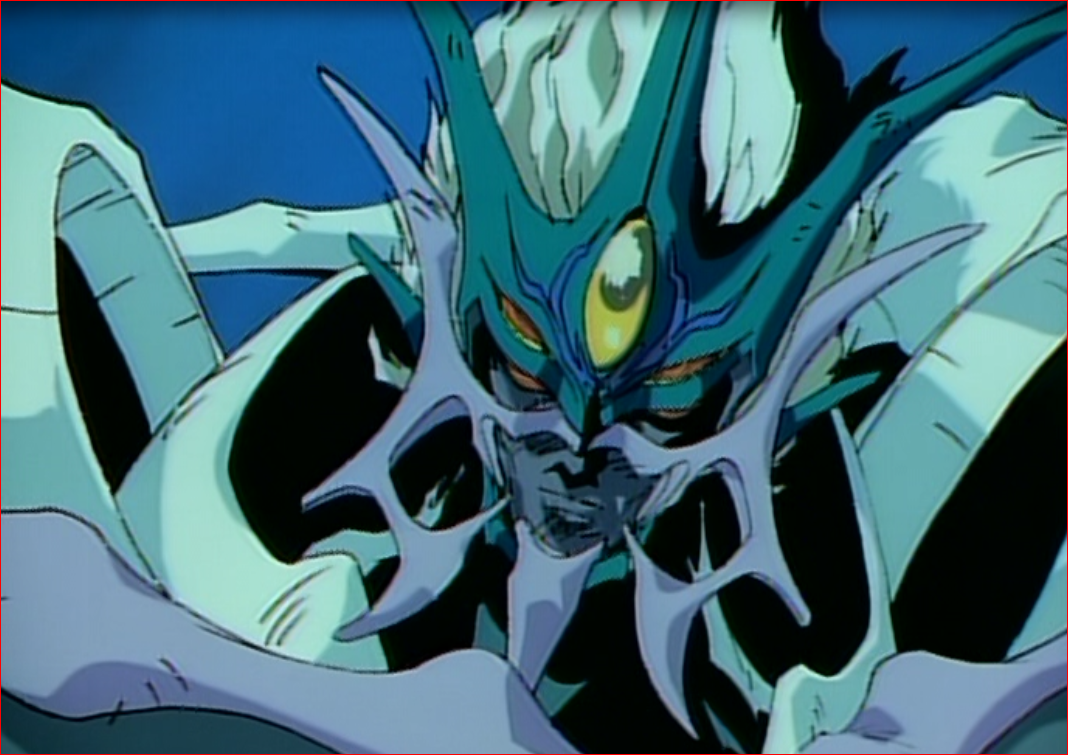
 The only thing going for this animation is the artwork, design, and music.  Of course, I went into this for the music, and it didn't disappoint.  In fact, it should be made an example of.  I don't know how Seikou Nagaoka does it.  He must get some kind of feeling watching this.  It definetly wouldn't keep you entranced if it was for the rocking soundtrack.  Character designs are standard fare, with the exception of Isenagi and Isanami.  Ohbari's monster designs are hard to surpass.  Hiruko would have to be my favorite, especially the face's armor, directly above.  Animation, like I stated at the end of the last paragraph, is fluid at times, and then they take shortcuts.  English voice cast is lifeless, but at the Japanese track is definetly a lot more lively.  Where its quite in the English version, there is a party in the Japanese. 

It is not an really worth the original price, but I have kept it.  I didn't pay much for it.  Unreel Magazine states on the back of the box, "Watch it, enjoy it, then go back and watch it again!"  Though, thats what I've been doing, but not to watch, to listen.  That comment is one of those damned marketing and sale enhancing tools.  I certainly encourage you to watch this.  I want to rewatch just to understand the mythology.  I have my reasons for popping this back into my player.  Other than that, it doesn't really warrant a repeat. 

Saturday, January 8, 2011

Spaceship Agga Ruter- ep. 1 Trouble Maker


I had a chance to get all four episodes back before I turned 18, but damn clerk wouldn't budge.  They were available, just until before my 18th b-day.  I was so bummed.  Last year I was lucky to find ep. 4 dvd and I loved it.  Just last week I obtained both of Kajishima's rare Hentai dvd's on ebay.  For a reasonable price of one episode.  I love the cover, it is epic.  Now on to the review.
First of all, your going to get into this knowing that your going to get freaked out.  I read all the warnings of the freakish sex relationships.  Opening started out like I thought, but I was still freaked out, even though I thought I was ready for the expected.  I don't know if Taiyo, is actually penetrating "his mother" Kei.  It looks more like foreplay.  It was neat to see the arrows, teaching Taiyo the points of feeling.  Whether or not that it's for visual or part of Kei's abilities, is not said.
 Then our pirate, Janis, comes in to capture them, during the pairs intercourse.  I won't spoil the show much for you, because I want you to want it.  I will mainly tell some points, and then the technical aspects that is attractive.  Such as, how this was done like on a real set.  Janis talks to the main villian, Shiunk, on the intercom through the cup on a wire.  Which is hysterical.  Janis' crew is comprised of robots and provide a little extra comedy.  While Taiyo woos Janis, the robots are also seen making love.
 I really do like the character designs.  Kei is the most interesting.  We get a lot of details on all the characters, but Kei is most often cut off from explaining.  Kei is obviously not human, at least not naturally.  Her expression is always the same.  Whether she's smiling, having an orgasm, mad, etc, her eyes will always be slim like the chinese.  She hasdwierd green pieces floating around her head and her hair is extended and becomes like a computer connection.


The animation is as beautiful as Tenchi Muyo.  Ship designs are not your norm, but again not as great as Atsushi Takeuchi, the design artist for Tenchi.  I like the Agga Ruter, but we don't get any info on it.  I like the music that plays for Kei and the Agga Ruter, it's mysterious. 


Expect to be annoyed by the voices.  There is no talent at anime 18 productions.  It's the same quality voice you get from a kindergarten teacher to the kids.  Yet this is dealing with sex, which I call this logic absolutely contradictory.  Some of the voices actually fit.  Like Kei's is perfect for her cool and knowledgeable personality.  She never gets that annoying high picth anime voice, like Janis' voice does.  Shiunk V.A. plays his part well.  Same with Taiyo, he gets that oblivious and dumbfound sound that Taiyo is. 

A great start for the series.  Never a dull moment, if you can get past the distastful voice.  Still it's not bad quality.  There is lots of good info on K-sensei's universe.  Lots of hijinks, which is a plus, yet for some reason it feels short.  The whole episode is fun, and when it ends, I feel like it didn't start.  

Thursday, January 6, 2011

The Vision of Escaflowne- Ep. 1

I am a very picky person, and rarely accept things out of my liking.  I was at the library and saw the whole series on DVD and decided to give it a try.  Opening Menu sounded like a church, Gregorian style, chanting the title, how lame.  That is Yoko Kanno and Mizoguchi.  I've tried some of Kanno's work, but her music is too aural or breezy.  So far, I hear the music but I still can't notice it. 
 Nice poster.  Cels are a little too shiny.  Just click to get original size. 

I am not a fan of robots or alternate worlds.  Those are some of the reasons it kept me away.  It's also a rip of El Hazard, which I will get to reviewing soon.  The  first half of the show bored me, as do most openings do.  Most openings in many series, start off at school.  El Hazard does, Tenchi does, Takegami does.  We in America have no idea what school is.  It's always incoporated on tv in Japan. 
So after the halfway mark, Vaughn, appears on Earth, which is where the action begins, following the dragon that is appearing from a dimensional.  I found it odd how the dragon was crossing worlds.  It is neatly designed.  It looks like a frog from the chest. 


That is the first time I've seen a shield come out like that.  It was really neat.  The dragon gives chase well.  Thanks to Hitomi's vision, she saves the warrior, and is able to slay the beast.  He pulls out its energy source I guess and it rots away. 

Vaughn came out almost unthankful, and Hitomi was deeply hurt by his arrogance.  I didn't like how that offense was handled.  He was snobby, and the girl was a baby.  The character interaction is just too typical.  After that, Vahgn and Hitomi are transported, ending ep. 1.

Not too much for me to draw on.  This only episode one.  I'll watch a couple more before I decide to discontinue.

Wednesday, January 5, 2011

Tenchi Muyo! Ryo-Ohki-Ryoko's Ressurection

LD Jacket design.

I was going to do like astronerdboy and review by sets, but I decided for the first OAV I would flesh out some points about the production.
OK, then.  A little introduction, this was first released in Aug. of 1992.  Hayashi Hiroki and Masaki Kajishima started the rough drafts and hired Naoko Hasegawa to bring it together.  In this episode, we see Tenchi's curiousness get the better of him, thanks to his grandfathers influence.  The influence brought Tenchi to do what he was told not to.  Though aren't we glad that he didn't listen. 

English voice cast is excellent.  It's not cheesy at all.  Of course, I would like to give a tribute to Petrea Burchard, whom played Ryoko very well, better than Ai Orikasa, the seiyuu(japanese cast). 
 What draws me most is the magnificent artwork, animation, and music.  The opening music is very fitting.  Music is just hard to miss.  For this episode, it felt more like sound effects, to portray the oni(demon) in the cave. 
The blade in the legend really attracted me.  I can't find a picture of it and I don't know how to do a screen capture.  Even cooler is the sword Tenchi pulls.  The powers that Ryoko poses are new and fresh.  The laser swords come out much better than in Star Wars.  The fight between Tenchi and Ryoko beats all Star Wars movies.  The animation was very fluid. 


 Another thing that sets it from other anime is the script.  I believe thats Hayashi and Hasegawa.  They make character interaction real.  We get in Tenchi's head plenty of times.  Lines didn't get dull. 

                                                                      Ryoko, Sex on the Beach.
 This is a reason I am seperating my reviews.  Tenchi has a lot of extra material and I want to share them with you.
 Masaki Kajishima and AIC's finish work at their prime.
I like that the episode ends with a "To Be Continued" mark.  It doesn't happen all throughout series.  I don't like when each episode begins like nothing happened before, which does happen alot.  Like on sitcoms, the main character was hurt badly in the last episode, almost handicapped, and moving like a monkey in the next.
 This is from Hitoshi Okuda
 This is a rare cel.

Santa Vixen

 Ryoko's a Beach-hog.
So a great episode.  Swords, music, action, blasting, the words, the feelings, all filled it up.  Enjoy the images.
Show off.